Whole horse veterinary rehabilitation
Cases taken for individualised veterinary rehabilitation on a track system
Have your horse cared for by a vet to recuperate from injury and chronic pain, to regain functional posture and movement, and to change behaviour by addressing the way they feel.
Cases taken on by me for whole horse rehabilitation at my facility on a track system in West Sussex, UK. I am a veterinary surgeon with expertise in species-appropriate lifestyle, postural rehabilitation, ethical behaviour modification, and ecology. This unique perspective means I treat the body, mind, and emotions together, and honour their wider ecosystem, enabling true, profound, long lasting changes to health and wellbeing.
Please contact me or use the form to enquire below to tell me about your horse and what you need help with.

What types of case is this rehabilitation service for?
-
If your horse is either not recovering as expected from injury or keeps re-injuring, has widespread pain, discomfort or dysfunction, or has an underlying illness that may be related to lifestyle and management factors that are outside of your control, a rehab livery stay with me can help. I look at the whole horse and consider how the body is currently functioning, then work through rebuilding functional body systems if this is possible. I don’t promise to resolve all cases, but explore how to keep your horse as comfortable and functional as it is possible for them to be.
-
If you are trying to rule out sources of pain, discomfort and dysfunction in your horse and it is either proving difficult or confusing, an in-depth assessment over a period of time may be the answer. These are not suitable for urgent cases, but if your horse either has long-standing mystery discomfort, has had diagnostics and you are not sure which results are relevant or where to start, or your horse is challenging or impossible to examine or treat in a clinic environment, a rehab stay with me can help. I carry out non-threatening assessments and establish two-way communication that gives the horse agency in the process and can change the horse’s mind about being examined and treated. I look at the deep rooted causes of discomfort and dysfunction and how they all interconnect to make a plan of how best to proceed to alleviate this.
-
If you have been unable to achieve a thorough veterinary work-up, veterinary, farriery or husbandry interventions, or similar because of behaviour your horse shows when you attempt these, I can work on these over time with your horse on full livery. These livery stays are good for cases where there may be complex physical, mental and emotional reasons for your horse’s response to being examined and treated, and cases where you would prefer for the foundations of behaviour change to be built before you can then continue to work with your horse at home. I also offer teaching on this subject both via online courses and in person teaching if you would prefer to address it at home.
Whole horse rehabilitation boarding options
-
Stays lasting between one and three months. Ideally suited for:
Starting off the process of barefoot rehabilitation - whether taking your horse out of shoes or for existing barefoot horses with pain or known pathologies
A comfort reset - understand and alleviate your horse’s pain and anxiety
Injury recovery - appropriate nutrition, foot care and exercise to aid healing and conditioning
Vet-phobic, needle shy, unable to handle feet, and more behaviours linked to pain, dysfunction or trauma and that may be interfering with being able to follow a diagnostic or treatment plan satisfactorily
Adjusting to a track lifestyle from a more traditional horse keeping setup - if you are wary of your horse going from a stable to a suddenly different lifestyle, or for helping post-gelded stallions adjust to freedom and learn appropriate social skills
Prehabilitation for young horses - an excellent foundation of preparation of their body and mind for lifelong husbandry and veterinary procedures like foot handling and needles, installing foundation training skills, and conditioning their feet and body for future athletic demands like riding
Included is teaching for you throughout and ongoing support when you take your horse home.
Price for first month starts around £2100, subsequent months around £1800 - see example breakdown here
-
6-9 month postural and injury rehabilitation, 18-24 month postural rehabilitation or injury management
Ideally suited for:
Rehabilitation of ligament, tendon, and upper body injuries with needed adjustments to feet and dentistry, appropriate movement and exercise (6-9 months)
Complete whole horse postural rehabilitation requiring 1-2 hoof capsule growth cycles, three dentals, long term species-appropriate lifestyle, and regular postural exercises (18-24 months)
Long term veterinary management of complex pain, dysfunction, and health conditions (case dependent)
Boarding fee starts at £1250 pcm, plus rehabilitation services - see example breakdown here
-
The 10 day intensive format doesn’t feel so intense from your horse’s point of view - it allows them to relax and decompress in a species-appropriate environment and therefore to show us more of how they feel, where they hurt, and what they need.
The 10 days is intensive with regards to information gathering and helping your horse. It allows an in-depth assessment of your horse over multiple days, particularly useful when horses are highly stressed, stoic or guarded about showing us things, or have subtle, intermittent, or context-specific physical or behavioural signs.
In this time period, I can identify the aspects that will be most helpful to focus on and in what order in ongoing rehabilitation and management when they go home. I set them up for this by starting off the rehabilitation process during their stay and teaching you the approach and techniques. Included is follow-up support with this when your horse goes home.
Ideally suited for:
Complex or long-standing cases of known or suspected pain that are not resolving
Vet-phobic, needle shy, unable to handle feet, and more behaviours that are linked to pain, dysfunction, or trauma and that may be interfering with being able to assess or help your horse in a single day workup
You will get:
Total peace of mind that your horse's physical, mental, and emotional wellbeing are taken care of during their stay and planned for when they go home
An answer to the questions - have we really ruled out pain? Is this diagnosis the full story? Is my horse's behaviour a physical or a training problem? and What do I need to be focusing on to best help my horse?
In-person teaching during your horse's stay and follow-up support when your horse goes home
A deeper understanding of your horse's body, mind, and emotions, and an improved relationship with them.
This is the start of a journey for you and your horse better understanding each other, communicating clearly, and finding joy together again.
Price starts around £1500 - see example breakdown here

What do I assess and provide your horse?
This is a full boarding service including all daily care, hay, feed, and supplements, with an individualised plan for their nutrition, feet, teeth, remedial exercise, bodywork, any medication, and training. It also includes regular teaching for you and ongoing support when your horse goes home. Length of stay will depend on the nature of your case - see the boarding stay options.
My approach is to identify and tackle the deep rooted causes of discomfort and dysfunction. I carry out serial Whole Horse Reviews during their stay and rehabilitate posture via work on the comfort, alignment, and function of their body, feet, teeth and jaw. Living a horse-appropriate lifestyle is of paramount importance for this. All this allows their body to recover from their injuries and chronic pain. I address behaviour by getting to the root cause of it and by using only ethical training approaches.
-
Lifestyle and management have a huge influence on physical, mental and emotional health and wellbeing. In fact, domestication of horses is responsible for a huge amount of the signs of unease that our horses show. Having said that, now that they are in our care it is our responsibility and gift to provide them with as healthy a living situation as possible.
In many cases some aspects of lifestyle form part of the root cause of illness, injury, and behaviour. This could include housing, social interactions, feeding and nutrition, foot care, dentistry, and more.
When your horse is on rehab livery with me I will provide a lifestyle as appropriate to their needs as I can, and explore with you how we can replicate this when they go home.
-
Static and dynamic posture (how horses arrange their body and limbs at rest and in motion), development of the musculoskeletal system, and the ability to choose to move are all fundamental to all round horse health and wellbeing. When your horse is on rehab livery with me I will assess their posture and movement and help to nurture this to become healthy and functional via lifestyle, bodywork, aligning feet and teeth, and training.
-
Organisms in discomfort, whether physically, mentally or emotionally are not able to function and enjoy life as they otherwise could. Discomfort underlies or results from many illness and injuries and gets in the way of recovery. When you horse is on rehab livery with me I will identify sources of discomfort and remedy these where possible.
-
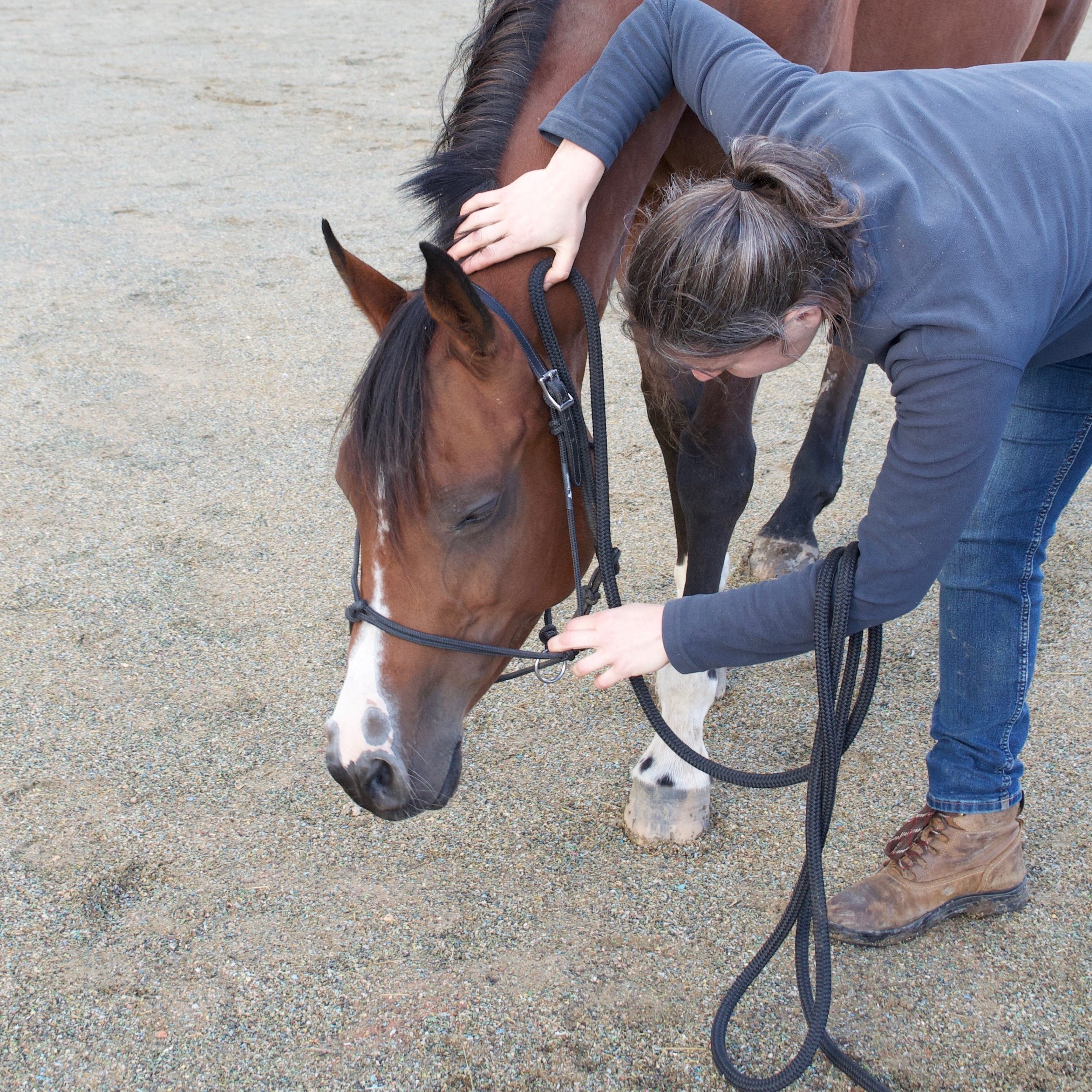
I strongly believe healthy relationships and having choice and agency are fundamental to all round health and wellbeing. When your horse is on rehab livery with me I will explore their relationship with humans in general and certain questions we ask of them specifically and, if they struggle with these, offer them a way of interacting through communication, compassion and consent.
My philosophy - the four deep roots to health and wellbeing

This service is for horses who:
• Have an injury or chronic movement dysfunction - suspensory ligament desmitis, navicular syndrome, osteoarthritis, kissing spines, nerve damage or impingement, and more - have a vet design and carry out an individualised recovery programme and long term plan.
• Don’t yet have a diagnosis but are showing signs of pain, especially if it is proving difficult to localise or diagnose
• Require barefoot rehabilitation - either taking them out of shoes, or need to improve foot comfort, structure, and function
• Have been recommended retirement or even discussed euthanasia because of their injuries or behaviour (I do not claim to be able to reverse these cases, but I can offer a very in-depth second opinion by observing your horse over a longer period of time and trying a holistic approach)
• Are difficult to achieve a veterinary diagnostic work-up or treatment on because of severe needle shyness or other behavioral signs

Your horse’s length of stay will depend on what your horse needs. When recovery has proceeded enough for your horse to go home, we will then work together to create the best situation for you and your horse back at home with you. Spaces are extremely limited so that I can give lots of time to each horse during their stay.
During your horse’s stay they will have all their daily and regular health needs looked after (full livery only). This includes:
• A species-appropriate lifestyle with free choice forage balanced to their unique nutritional requirements and any metabolic conditions, 24/7 access to both group shelter and movement on a track system with hardstanding and covered barn area with plenty of horsey company
• Serial Whole Horse Evaluations consisting of assessing and then addressing hoof and dental balance, whole body posture, saddle fit, pain and compensation patterns, emotional state and training foundations
• Remedial exercise including postural reset exercises, in-hand work, play and scentwork movement sessions, hand walking out using different terrains and inclines, and bodywork
• Work on ethical behaviour modification if needed for husbandry and veterinary interventions or other behavioural signs - this involves addressing pain, discomfort, fear, metabolic and emotional state, and ability to learn, as well as ethical training approaches

During your horse’s stay you will have:
• No worries that your horse’s recovery is being planned, carried out, and monitored by a vet
• Visits by appointment with demonstrations and teaching on assessments and how to continue rehabilitation when they go home
• Frequent message updates and weekly detailed updates on your horse’s assessments and progress
• A detailed plan for going home with ongoing support
• The opportunity to come back for the day for resets when needed
• Help with making difficult decisions if needed.


Estimated costs include:
• All daily care - hay and water, checks, daily care of feet, grooming, changing rugs if worn
• A personalised nutrition plan and all feed and supplements
• Enrichment and games in the form of 24/7 access to forage, shelter, horsey company, herb stations, food puzzles, and scratching spots
• Faecal egg counts, tapeworm saliva testing, and wormers
• Serial Whole Horse Evaluations to plan and monitor the rehab process
• Hoof trimming and hoof boot fitting as needed in your horse’s unique case (hoof boots themselves and remedial shoeing are additional)
• Dental occlusal equilibration including sedation - this is more than just dental floating, it means to balance the chewing surfaces of all teeth in the mouth to enable normal jaw function and correct posture and movement
• Ethical behaviour modification via identifying and addressing deep rooted underlying causes for behaviours, plus a combination of ethically carried out positive and negative reinforcement training
• Rehabilitation exercise as needed for each individual case - whether in-hand walking, lungeing, liberty work, ridden, and specific postural exercises
• Body work to release muscle tension, reset postural signalling, release nerve impingements, and nurture emotional wellbeing
• Evaluation of current saddle fit and saddle fitting if required
• Emergency veterinary first aid - for example if your horse has a wound or colic.
Not included and charged on top are:
• Hoof boots
• Remedial shoeing
• Diagnostics such as blood, urine and skin tests, and imaging such as x-rays, gastroscopy, or more involved diagnostics involving external labs, external vets, or visits to an external veterinary hospital
• Emergency veterinary interventions beyond first aid, including if treated by external vets or if transported to an equine hospital
• Long term medications (but planning and administering these during their stay is included)
• Fitted and new equipment that will go home with them after their stay - saddles, halters, hoof boots, and similar.

Meet Lily

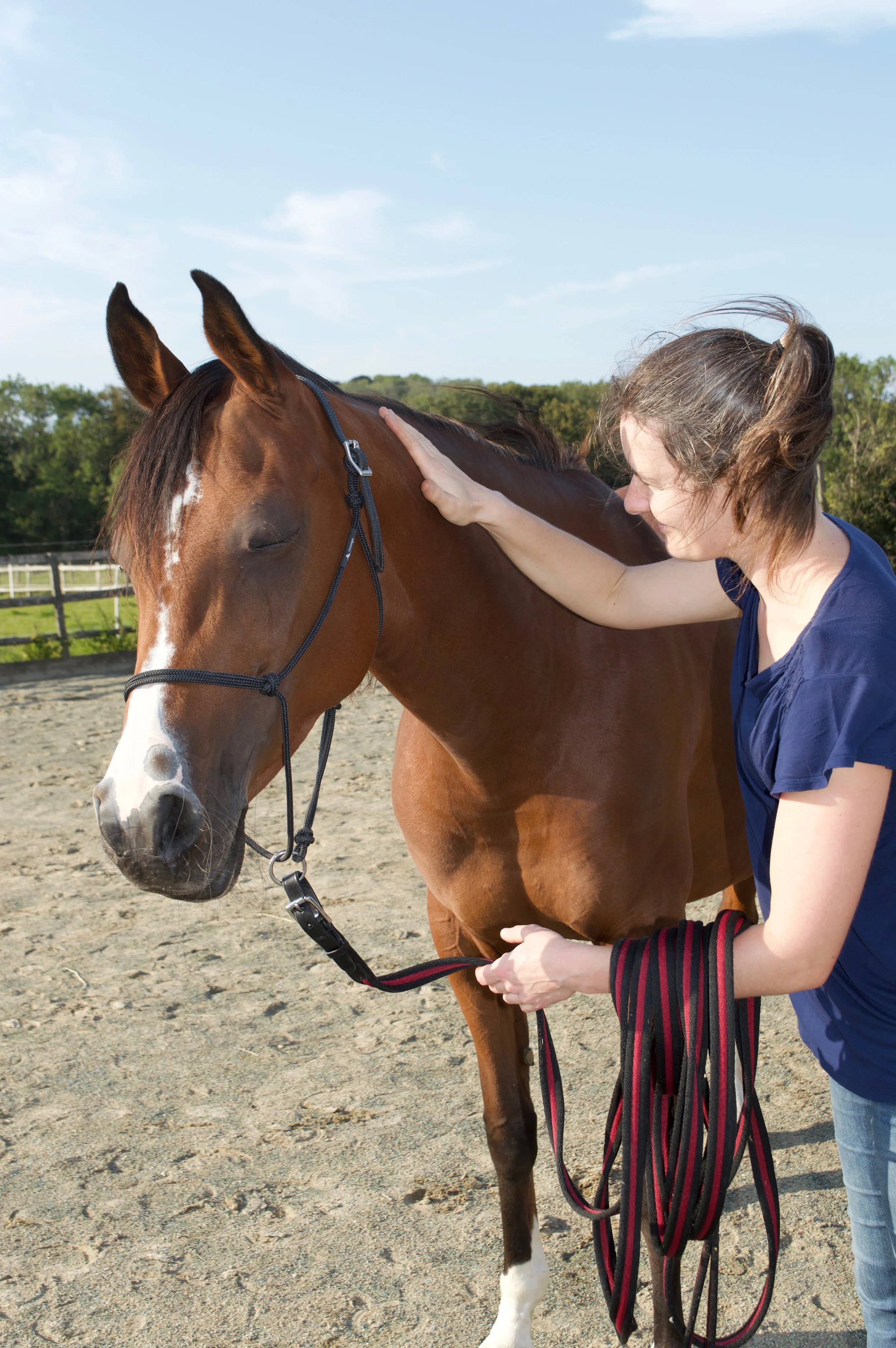
Hi, I’m Lily, I have been a vet since 2016, initially in general mixed practice, and over the last few years I have changed my approach. As well as my patients, my own horses, particularly Sunny and Beau (pictured here) have taken me on quite a journey and have guided me through developing this new approach.
My passion is helping people and animals to live their best life together by nurturing their all-round wellbeing and unique partnership. I am fascinated by all aspects of wellbeing from how the body functions in health and disease to how we all learn, think and feel, and how all of this is intertwined. I want to help people on their journeys of discovering how to keep horses’ bodies and minds healthy, comfortable, active and engaged and to explore the integral role of both the horse’s and our emotions in all of this.
Developing a whole horse approach to health and wellbeing has taken me studying all over the world, particularly the US. I am the only vet in the UK who is a Postural Rehabilitation practitioner. I practice dental occlusal equilibration, which is far more than just floating teeth to remove sharp points - it restores jaw alignment and function, which affects hoof and whole body alignment and function. I also practice rehabilitative barefoot trimming, various forms of postural reset exercises and bodywork, saddle fit evaluation, and ethical behaviour modification.
I look forward to meeting you and your horse!

What clients have to say…
Dawn with Tonto, 14 yo ISH gelding
“Whilst actually very stoic and obedient Tonto has always been quite sensitive in the ridden and despite multiple adjustments to training, tack and management including veterinary care -and holidays with “Dr Green” his ridden feel never aligned with his non ridden. Over time this general concern of his became dangerously explosive episodes and still all his professionals could find “nothing wrong”.
After a chance encounter with Lily at the Warwick Schiller podcast event in Texas we had an online consultation in which Lily could identify twelve things from postural and movement analysis which might be indicative of pain being the cause of our problems.
A frustrating year followed working with vets, dentists, farriers, podiatrists, bodyworkers and livery yard owners all of whom were open to working with Lily’s advice but given the constraints of their own practices and situations couldn’t be in the same place at the same time or necessarily offer the environment required and meanwhile Tonto’s feet and posture became increasingly compromised and it was becoming obvious that his choice would be not to move wether ridden or not and he lost muscle and gained weight as a result.
I took the heartbreaking decision to move him to Lily’s care - a four hour round trip from my home in the hope that her integrated holistic approach including friends and freedom would at least fulfill his needs and possibly start him on the road to becoming a healthier horse.
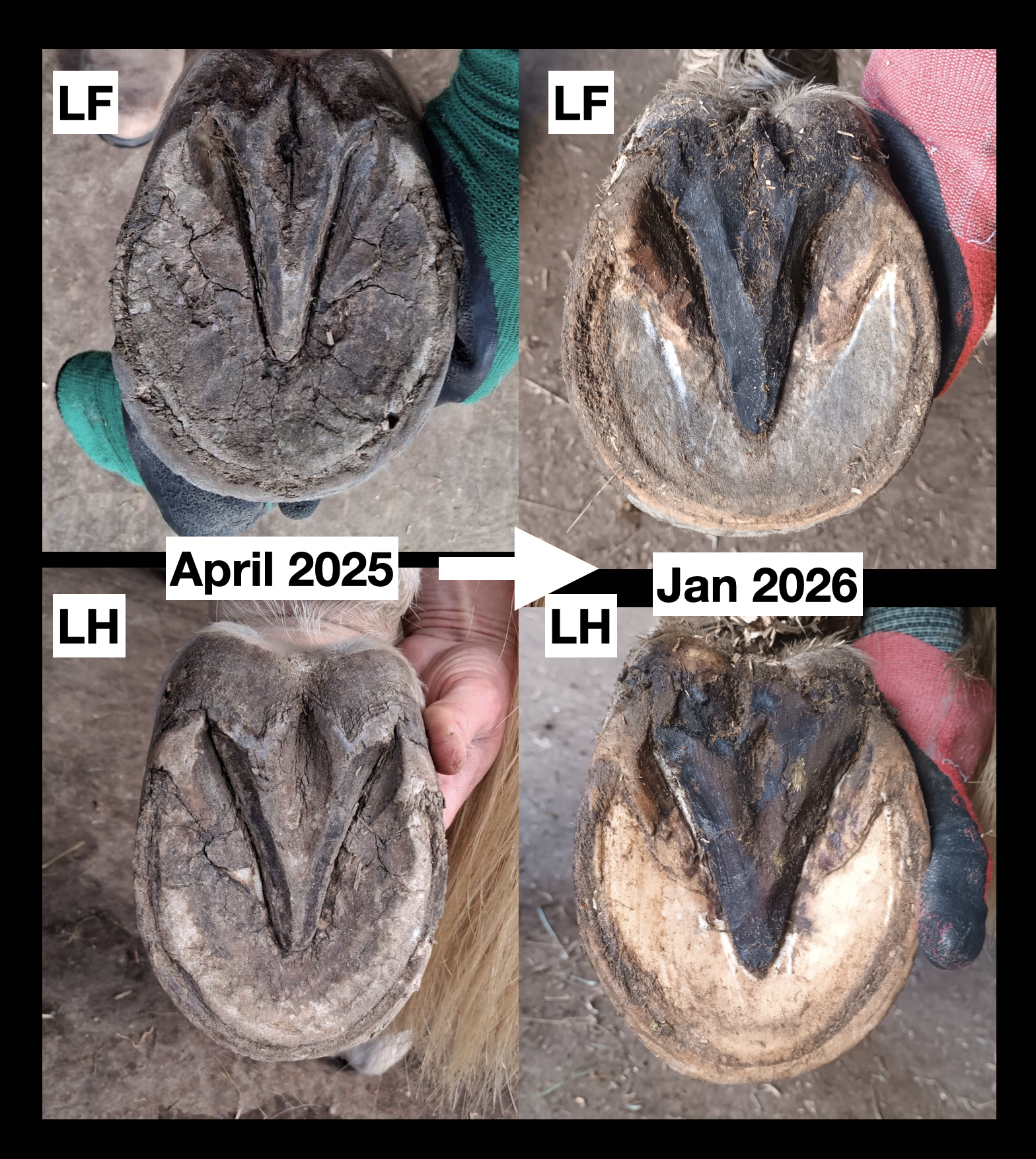
The environment Lily and her herd provides has seen Tonto improve in so many respects - most notably his feet which have always been a challenge. He had crumbly walls, thin soles, white line separation, negative angles and crushed heels. He was visibly uncomfortable (footy) after each trim.
Living with Lily has meant constant observation, monitoring and tweaking of his care. No one thing has been the solution but a combination of an environment that promotes social interaction and regular movement, a diet with supplementation geared toward his individual needs, regular trims and a plethora of footwear options to try try and try again and a physical care programme with a broad plan for improvement but flexible to allow for his mental/nervous system capacity each day.
Much quicker than expected Tonto’s feet have completed a whole cycle of growth.
His hoof wall hasn’t chipped this summer, he has tight lines, good angles improved sole depth and healthy heel bulbs.
Comfortable feet (and playful friends) have encouraged him to move more and this prompts his body to heal itself.
It is an absolute joy to watch Tonto walk up the track with loose shoulders and a swing in his barrel, trotting eagerly to be the first to reach the grass paddock or just take himself around the track for a floaty canter because he can.
He still has some issues to work on but with comfortable feet and Lily’s attuned assessment these are now easier to identify and the way forward is revealing itself.
It’s hard to watch your horse suffer and not to know what to do for the best and it’s equally hard to relinquish our much loved equines into someone else’s care (particularly if it’s not ended well with other professionals) which is why we often leave the decision til all other avenues are exhausted.
With hindsight…I would have saved so much time and money (not to mention the patience of my long suffering lovely boy) if I’d just moved him to be with Lily in the first place- which in my gut I had probably always known I would do. Many facilities promise to treat your horse as their own - I know from experience that Lily’s knowledge and care far surpasses any that I could offer myself or have witnessed available elsewhere.”